Conscientious use of AI
How do we use AI in instea so that it is safe(r) and legally cleaner? A slightly opinionated look at how we use AI coding assistants from a legal and security perspective.
Of course, we started experimenting with AI a long time ago, but over time we came to a few basic principles we follow.
AI is a tool; we are the builders
In the time of vibe coding, everyone can build software. Maybe not of any scale and complexity, but many useful tools can be built by almost anyone.
This also has its own risks. Is it secure enough? Does it scale enough? Does it break when adding new functionality? To be fair, we (developers) also have problems in these areas, but we are trained to deal with them.
In instea, we believe AI used in good hands can greatly improve productivity. But it is just a tool, and we are still responsible for the code we produce. We review it, we test it.
Limit what agents see
The principle of least privilege was here also before AI. However, as AI is more powerful, it also brings more risks. As we have discussed, limiting agents can not only improve security but also improve accuracy.
AI agents shall have harnesses for these reasons. You can, of course, tell an agent not to do bad things, but it can always hallucinate or disobey your directions. Agents are susceptible to prompt injection. The best way is to "physically" limit what the agent can do.
The best compromise between security and developer experience seems to be development containers. It has several benefits:
- All developers have the same environment (no "works on my machine")
- The agent can't reach your host machine directly (e.g., no access to all your SSH keys) unless you explicitly provide it to the container (and the agent running in it).
Devcontainers also nicely help with supply chain attacks that are recently very widespread. Even Microsoft published some compromised packages with a credential harvester.
Use package manager's protection
One complementary measure is to use different security features that, e.g., don't allow installing too young dependencies or executing different post-install scripts.
Recently, pnpm has become our favourite, but others will catch up soon.
Legal limitations
This was the biggest surprise to me. As we researched with our lawyers, we found out you can't use any paid AI coding assistants for commercial use.
This is not legal advice. Terms can change over time, and your situation can be specific.
- Claude Pro and Max plans fall under the Consumer Terms, and you can't use them for commercial use.
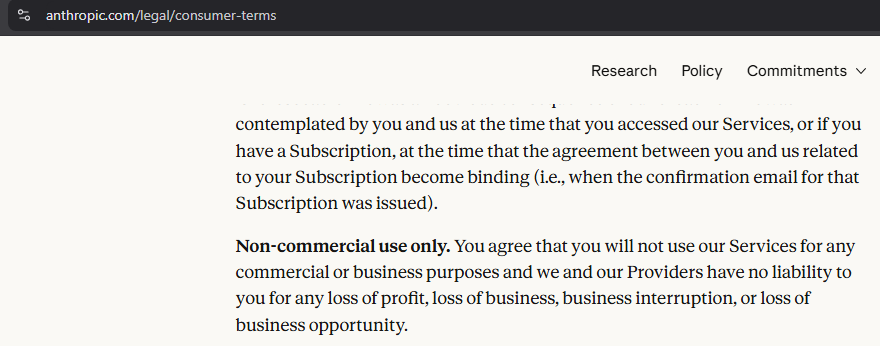
You need at least Claude Team to enjoy the benefits of the Commercial Terms, which also include IP Indemnification (Anthropic will defend Customer when its output violates any third-party intellectual property right).
- Cursor can be used for financial or medical software, and you are on your own if LLM output violates IP rights.
There are even more nuances, but the lesson learnt is that you should always read Terms and Conditions, especially when conducting business.